Have you ever looked at a time card and seen numbers like 8.25, 7.50, or 6.75? It can be a little confusing at first. Most of us are used to thinking about time in hours and minutes, not decimals. So when minutes show up as fractions of an hour, it’s natural to wonder what those numbers actually mean.
Here’s the good news: decimal time is a lot simpler than it seems. Once you get the hang of it, reading and understanding these numbers becomes second nature. In this guide, we’ll break down what decimal time is, how to read it, and share a few easy examples to make it all click.
Table of Contents
- What Decimal Time Looks Like
- Why Time Clocks Use Decimal Numbers
- Simple Examples of Decimal Time
- Reading Decimal Time on a Time Card
- The Quick Way to Think About Decimal Time
- Still Confused? Learn the Full Conversion Method
- Frequently Asked Questions
- Understanding Decimal Time Gets Easier With Practice
What Decimal Time Looks Like
Most of us are used to thinking about time in the standard clock format. An hour has 60 minutes, so you’d typically write something like 1 hour 30 minutes or 2 hours 45 minutes.
Decimal time works a little differently. It shows those same minutes as a fraction of an hour. Instead of using a colon to separate hours and minutes, it uses a decimal point.
It might look a bit strange at first, but it’s actually pretty straightforward. The number before the decimal tells you how many full hours were worked. The number after the decimal shows the fraction of the hour.
| Time Format | Example |
|---|---|
| Standard clock time | 1 hour 30 minutes |
| Decimal time | 1.50 hours |
| Standard clock time | 2 hours 15 minutes |
| Decimal time | 2.25 hours |
| Standard clock time | 3 hours 45 minutes |
| Decimal time | 3.75 hours |
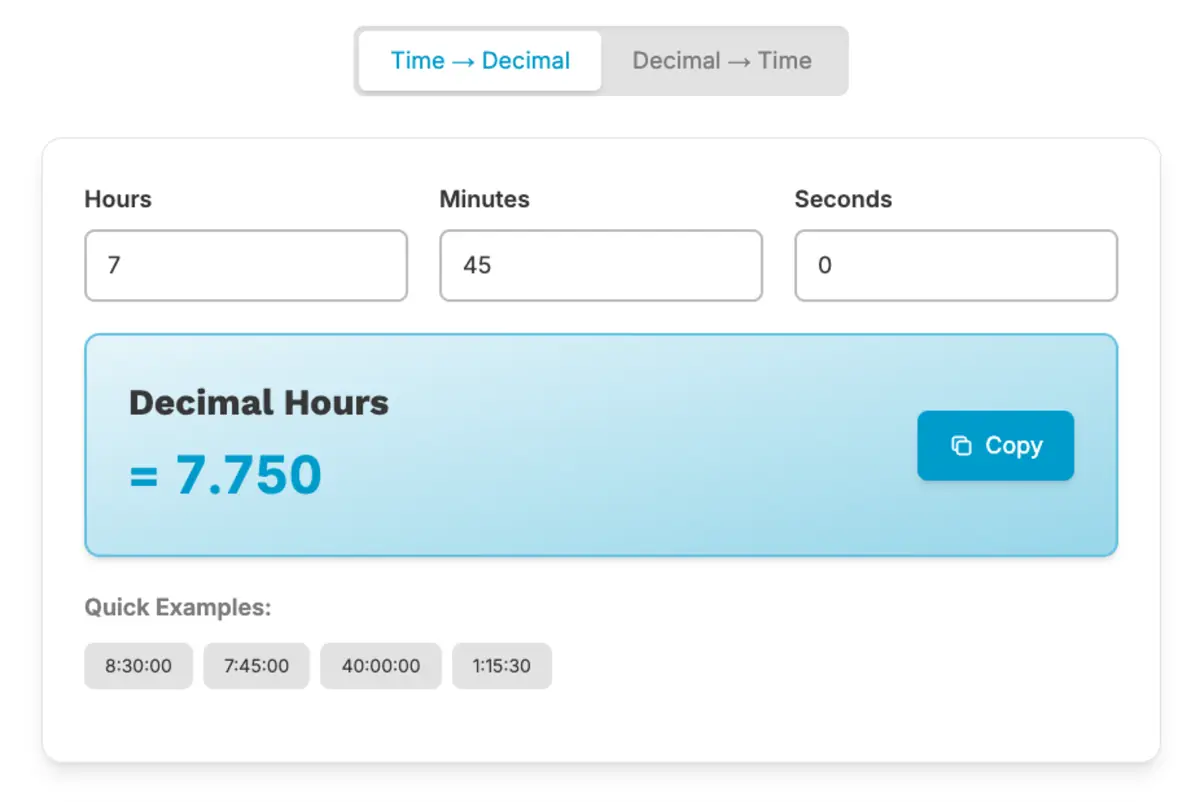
For example, if you see 7.50 hours on a time card, it doesn’t mean 7 hours and 50 minutes. It means 7 hours and half an hour, or 30 minutes.
This format makes calculations much easier because the minutes are already converted into fractions of an hour. That way, payroll math is as simple as multiplying decimal numbers, without needing to convert hours and minutes separately.
Why Time Clocks Use Decimal Numbers
When employees track their hours, they usually think in terms of clock time. For example, a shift might run from 8:00 to 4:30, or someone might spend 2 hours and 45 minutes on a task. That format is easy to read, but it gets tricky when it’s time to calculate payroll.
Payroll systems need to multiply the hours worked by an hourly wage. If time stayed in the traditional hours-and-minutes format, every calculation would require converting the minutes into fractions first. Decimal time simplifies this by automatically converting the minutes for you.
For instance, instead of figuring out pay for 7 hours and 30 minutes, a time card can just show 7.50 hours. Since the minutes are already expressed as part of the hour, payroll calculations become as simple as multiplying two numbers.
This is why time clocks and payroll systems often use decimal hours. It speeds up calculations and keeps the numbers consistent across reports, timesheets, and payroll processing.
If you’re curious about why payroll systems rely on decimal hours, this guide dives into the details: What Are Decimal Hours and Why Payroll Uses Them
Simple Examples of Decimal Time
Once you know that decimal time represents a fraction of an hour, the next step is to look at some common examples. Certain minute values pop up a lot on time cards, and learning these makes it much easier to recognize decimal time at a glance.
Most people start by memorizing the quarter-hour increments. These are the ones you’ll see most often in payroll reports and time card summaries.
| Minutes Worked | Decimal Time |
|---|---|
| 15 minutes | 0.25 |
| 30 minutes | 0.50 |
| 45 minutes | 0.75 |
Here’s what those decimals look like in a full time entry:
4.25 hours means 4 hours and 15 minutes
6.50 hours means 6 hours and 30 minutes
8.75 hours means 8 hours and 45 minutes
Since the decimals represent parts of an hour, they’ll always fall between .00 and .99. The number before the decimal shows the total hours worked, while the decimal part represents the minutes as a fraction of the hour.
If you're new to decimal hours, seeing the concept visually can help it click. This short example walks through how minutes like 30 appear as decimal hours on a time card.
Seeing the concept visually can make decimal time easier to understand, especially when you're reviewing time cards or payroll reports.
If you'd like to see a full conversion chart used by payroll departments, the North Carolina Department of Labor provides an official minutes-to-decimal hours chart.
Once you’ve seen these examples a few times, it starts to click. Recognizing common fractions like .25, .50, and .75 makes reading decimal time cards feel much more natural.
Reading Decimal Time on a Time Card
Once you understand that decimals represent fractions of an hour, the next step is learning how to read them quickly on a time card or payroll report.
Decimal time entries follow a simple pattern. The number before the decimal shows the total hours worked, and the number after the decimal shows the fraction of the hour.
Here are some examples you might see on a typical time card:
| Decimal Time Entry | What It Means |
|---|---|
| 8.25 | 8 hours and 15 minutes |
| 7.50 | 7 hours and 30 minutes |
| 6.75 | 6 hours and 45 minutes |
| 5.10 | 5 hours and about 6 minutes |
At first, something like 7.50 might look like 7 hours and 50 minutes. But in decimal time, the number after the decimal doesn’t represent minutes directly. It shows the fraction of the hour worked.
For example, .50 means half an hour, or 30 minutes. Similarly, .25 represents a quarter of an hour, or 15 minutes.
With practice, many payroll professionals recognize these patterns instantly. Numbers like .25, .50, and .75 quickly translate to 15, 30, and 45 minutes without needing to stop and calculate.
The Quick Way to Think About Decimal Time
If decimal time still feels a bit unfamiliar, here’s an easy way to think about it: imagine an hour divided into four equal parts.
Each quarter of the hour has a predictable decimal value. Once you get familiar with these patterns, reading decimal time becomes a lot simpler.
| Part of an Hour | Decimal Value |
|---|---|
| Quarter of an hour (15 minutes) | 0.25 |
| Half an hour (30 minutes) | 0.50 |
| Three quarters of an hour (45 minutes) | 0.75 |
With this shortcut, you can read most time entries almost instantly.
For example: 8.25 means 8 hours and 15 minutes (one quarter of an hour). 7.50 means 7 hours and 30 minutes (half an hour). 6.75 means 6 hours and 45 minutes (three quarters of an hour).
Most payroll entries stick close to these quarter-hour increments, which is why you’ll see them so often in time reports. Once you’re familiar with these fractions, reading decimal time becomes second nature, and you won’t need to stop and calculate.
Still Confused? Learn the Full Conversion Method

For most people, recognizing common decimal values like .25, .50, and .75 is enough to confidently read a time card. But if you’re curious about how those numbers are calculated, it’s worth understanding the process behind them.
When time clocks convert minutes into decimals, they’re turning minutes into fractions of an hour. It’s a straightforward formula, but it involves a few steps that are easier to explain in detail.
If you’d like to see exactly how the math works and learn how to do the conversion manually, check out this step-by-step guide: How to Convert Time Cards Into Decimal Hours
This guide walks you through the full conversion process and includes extra examples to help you double-check decimal time entries when reviewing payroll or timesheets.
Frequently Asked Questions
Decimal time can be a little confusing at first, and some questions come up pretty often. Here are quick answers to help clear up the most common points of confusion.
What does .50 mean on a time clock?
A decimal value of .50 means half an hour. Since an hour has 60 minutes, half of an hour equals 30 minutes. So if you see 7.50 on a time card, it means 7 hours and 30 minutes worked.
Is .75 equal to 45 minutes?
Yes, .75 represents three quarters of an hour. Since an hour is 60 minutes, three quarters of an hour equals 45 minutes. For example, 8.75 means 8 hours and 45 minutes worked.
Why don’t time cards just use minutes instead of decimals?
Using decimals makes payroll calculations easier. Decimal hours let payroll systems multiply hours worked by hourly wages directly, without needing to convert minutes into fractions every time.
Does .25 always mean 15 minutes?
Yes, .25 always represents one quarter of an hour. Since 60 minutes divided by four equals 15 minutes, any time entry ending in .25 means 15 minutes past the hour.
Understanding Decimal Time Gets Easier With Practice
Decimal time can seem a little strange at first. Numbers like 7.50 or 8.25 don’t look like regular clock time, which is why they might make you pause the first time you see them on a time card.
But once you know that the decimal represents a fraction of an hour, it’s much easier to read. Common values like .25, .50, and .75 quickly translate to 15, 30, and 45 minutes.
If you’d like to dive deeper into the concept behind decimal hours, check out What Are Decimal Hours and Why Payroll Uses Them.
And if you want to learn how to convert time manually step by step, take a look at How to Convert Time Cards Into Decimal Hours.
Not using TimeClick yet? Try our time clock software free. 10-minute setup, unlimited users, and built for small businesses. No credit card required.
Start your FREE TimeClick Trial Today.