On this page

Overtime laws trip up more employers than just about anything else. The rules sound simple, but once you mix in different employee types, pay structures, and state laws, mistakes happen fast. And when they do, they get expensive.
In 2023 alone, employers paid out nearly $494 million in FLSA collective action settlements, with overtime violations leading the way.
This guide walks through what actually counts as overtime, how it’s calculated under federal law, where businesses usually go wrong, and what you can do to stay compliant without turning payroll into a constant headache.
What Counts as Overtime?

Under federal law, overtime kicks in once a non-exempt employee works more than 40 hours in a single workweek. Any time over that limit has to be paid at a higher rate, usually time and a half (1.5×) their regular hourly pay.
A lot of employers assume that paying someone a salary means overtime doesn’t apply. That’s a common mistake. What matters is how the employee is classified under the Fair Labor Standards Act (FLSA), not whether they’re paid hourly or salaried.
Overtime is calculated weekly, not daily, unless you’re in a state like California where daily limits also apply. Those state-level rules can change how overtime adds up.
Here’s a quick summary:
- Overtime starts once an employee works more than 40 hours in a 7-day workweek
- Paid time off and holidays do not count toward the 40-hour total
- Any time worked over 40 hours must be paid at 1.5× the regular rate
- "Comp time" can’t be used in place of overtime pay (unless public sector)
Federal Overtime Laws: The FLSA

The Fair Labor Standards Act (FLSA) is the main federal law behind overtime rules in the U.S. It defines who qualifies for overtime, how pay is calculated, and what counts as work time. If you’re responsible for payroll, this law sets the baseline.
Under the FLSA, only non-exempt employees are entitled to overtime pay. Exempt employees are not. The tricky part is figuring out who actually qualifies as exempt, because the rules are more detailed than most people expect.
Here’s a quick breakdown of the two classifications:
| Classification | Eligible for Overtime? | Common Examples |
|---|---|---|
| Non-Exempt | Yes | Hourly workers, retail staff, assistants, warehouse employees |
| Exempt | No | Managers, professionals, executives, salaried administrative roles |
For an employee to be considered exempt, they usually have to meet all three of the following tests:
- Salary Basis Test: They’re paid a fixed salary rather than hourly wages.
- Salary Level Test: They earn more than $684 per week ($35,568 per year).
- Duties Test: Their actual job duties fall within an exempt category.
Which Categories classify as exempt?
- Executive: Oversees other employees and has real authority over hiring or firing decisions.
- Administrative: Handles office or business operations work and regularly exercises independent judgment.
- Learned Professional: Works in a field that requires advanced education, such as doctors or lawyers.
- Creative Professional: Performs original or creative work, including roles like writers, designers, or artists.
- Computer Employees: Covers roles like systems analysts, programmers, and software engineers.
- Outside Sales: Spends most of their time working outside the office making sales or securing contracts.
- Highly Compensated Employees: Earns $107,432 or more per year and performs at least some exempt duties.
- Academic Administrative: Applies to certain roles in educational institutions tied to curriculum or instruction.
For more detail on employee classification rules, you can review the DOL’s Overtime Fact Sheet.
How Is Overtime Calculated?

Overtime pay is usually calculated at 1.5 times an employee’s regular hourly rate for any hours over 40 in a workweek. On paper, that sounds straightforward. In real payroll runs, things get messy fast once bonuses, commissions, or different pay rates are involved.
Overtime pay usually follows this basic calculation:
- Step 1: Find the employee’s regular hourly rate.
- Step 2: Multiply that rate by 1.5 to determine the overtime rate.
- Step 3: Multiply the overtime rate by the number of overtime hours worked.
- Step 4: Add regular earnings and overtime earnings for the total pay.
Example: Hourly Employee
For example, an employee earns $18 per hour and works 45 hours in a workweek.
Regular pay: 40 hours × $18 = $720
Overtime pay: 5 hours × ($18 × 1.5) = $135
Total pay = $855
Example: Including a Bonus
When an employee earns a production bonus in the same week, that bonus has to be included in their regular rate before overtime is calculated.
For example, if they earned a $200 bonus that week:
Adjusted regular rate = (straight-time earnings + bonus) ÷ total hours worked
Overtime pay is then recalculated using that adjusted rate.
TIMECLICK TIP
Bonuses and commissions can complicate overtime math quickly. Use our free Time Card Calculator to double-check your calculations.

Overtime for Salaried Employees

One of the most common overtime mistakes is assuming salaried employees never get overtime. That’s not how the law works. A salaried employee can still be non-exempt and owed overtime if they don’t meet all the FLSA exemption requirements.
Here’s what determines whether a salaried employee still qualifies for overtime:
- Salary Level: Employees earning less than $684 per week ($35,568 annually) are generally non-exempt and eligible for overtime, regardless of their duties.
- Job Duties: To be exempt, employees must primarily perform executive, administrative, professional, computer, or outside sales duties.
- Salary Basis: Employees must receive a consistent salary that isn't docked based on quantity or quality of work (with limited exceptions).
If even one of these tests isn’t met, the employee should be treated as non-exempt and paid overtime for any hours over 40 in a week.
Example: Salaried Non-Exempt Employee
A salaried employee earns $600 per week and works 50 hours. Because their salary is below the $684/week threshold, they are non-exempt and entitled to overtime.
Regular hourly rate = $600 ÷ 40 = $15/hour
Overtime rate = $15 × 1.5 = $22.50/hour
Overtime pay = 10 hours × $22.50 = $225
Total pay = $600 + $225 = $825
It’s always worth double-checking both salary level and job duties before treating a salaried employee as exempt.
If you want to dig deeper, the Department of Labor’s Overtime Rules for Salaried Employees Fact Sheet explains the details.
Common Mistakes Employers Make

Most overtime problems don’t come from trying to cut corners. They come from small misunderstandings that pile up over time. Here are the mistakes that tend to cause the most trouble:
- Misclassifying employees: Treating someone as exempt when they don’t actually meet the salary or duties test can result in serious back pay penalties.
- Averaging hours across weeks: Overtime is calculated one workweek at a time, so you can’t average hours across multiple weeks to avoid paying it.
- Excluding bonuses or commissions: Non-discretionary bonuses still count and must be included when calculating the regular overtime rate.
- Failing to track all work time: Employees have to be paid for all time worked, including off-the-clock tasks like emails or remote work.
- Offering comp time illegally: Private-sector employers generally can’t replace overtime pay with future time off.
Small errors add up quickly, especially when multiple employees are involved. A few missed hours here and there can turn into serious liability before anyone realizes there’s a problem.
TIMECLICK TIP
Automate overtime tracking with TimeClick so problems don’t slip through unnoticed. Built-in alerts warn managers as employees approach overtime, making it easier to stay compliant.
Penalties for Non-Compliance

Getting overtime wrong doesn’t just frustrate employees. It puts your business at real financial and legal risk. The Department of Labor and private lawsuits actively enforce overtime violations, and the penalties add up quickly.
Here’s what overtime violations can cost your business:
- Back Wages: You could be required to pay up to two years of unpaid overtime, or three years if the violation is considered willful.
- Liquidated Damages: Courts often award double damages, which can mean paying twice what was originally owed.
- Fines and Civil Penalties: Willful violations can lead to civil penalties of up to $1,000 per violation and, in repeat cases, even criminal charges.
- Class-Action Lawsuits: A single complaint can grow into a large collective action involving hundreds or even thousands of former employees.
- Reputation Damage: Wage lawsuits are public record and can seriously damage your reputation with employees, customers, and investors.
Compliance goes beyond saving money. It plays a direct role in protecting your employees, your reputation, and your long-term financial health. For a clearer picture of what’s at stake, review the full list of DOL enforcement penalties.
That said, staying compliant isn’t always straightforward, especially in industries with long hours, lower wages, and high turnover. Department of Labor data shows that certain sectors consistently account for a large share of overtime violations and unpaid wages. Below is a closer look at the industries most at risk.
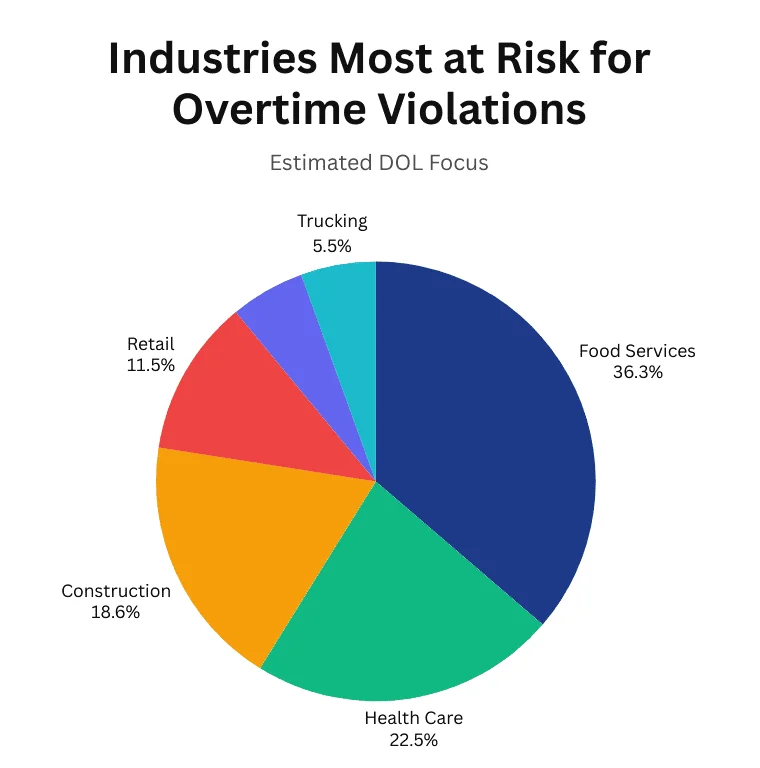
Top Takeaways:
- Most Investigated: Food Services, Health Care, and Construction saw the highest number of federal investigations and back wages recovered in 2024.
- Common Issues: Frequent problems include misclassifying workers as independent contractors, unpaid overtime, and poor timekeeping practices.
- High Violation Rates: In some personal service industries, such as security and janitorial work, studies found that 70 to 90% of investigations uncovered at least one violation.
- Real-World Impact: Unpaid overtime doesn’t just affect paychecks. It increases injury risk, financial stress, and legal exposure for employers.
Here’s a snapshot of labor investigations and back wages by industry based on 2024 Department of Labor data:
| Industry | Investigations (2024) | Back Wages Recovered | Common Violation Patterns |
|---|---|---|---|
| Food Services | 3,827 | $35.1 million | High turnover and seasonal work; unpaid off-the-clock hours common. |
| Health Care | 2,376 | $37.8 million | Nursing homes especially affected; long shifts, misclassified roles. |
| Construction | 1,966 | $32.1 million | Misclassified workers as contractors; inconsistent work hours. |
| Retail | 1,217 | $6.3 million | Fluctuating shifts; common wage theft and unpaid overtime. |
| Guard Services | 577 | $3.7 million | Often subcontracted; studies show 70 to 90% of audits find violations. |
| Trucking | 582 | $1.1 million | Drivers misclassified as contractors; unpaid long-haul hours. |
Not every employer in these industries is out of compliance, but this is where violations show up most often during investigations. Employees should track their hours carefully, and businesses should take a close look at their payroll practices.
State and City Overtime Laws
The FLSA establishes a national baseline by requiring time-and-a-half pay for hours worked over 40 in a workweek. Many states and cities go further, adding stricter rules such as daily overtime limits, double time pay, seventh-day premiums, or industry-specific protections.
If your business operates in one of these areas, you’re required to follow whichever rule is most favorable to the employee, whether that comes from federal, state, or local law.
| Jurisdiction | Daily OT | Weekly OT | Double Time | Special Rules |
|---|---|---|---|---|
| Alaska | After 8 hrs | After 40 hrs | No | Certain small employers and specific job categories are exempt |
| California | After 8 hrs | After 40 hrs | After 12 hrs/day or >8 hrs on 7th day | Includes seventh-day premiums and overtime protections for domestic and farmworkers |
| Los Angeles, CA (City) | Consent required after 10 hrs (hotel workers) | Follows CA | Yes, for exceeding daily room quota | Hotel workers earn double time when daily room quotas are exceeded |
| Colorado | After 12 hrs or 12 consecutive hrs | After 40 hrs | No | Farmworkers receive overtime after 48 hours; extended shifts over 15 hours trigger additional pay |
| Connecticut | None | After 40 hrs | No | Restaurant and hotel workers must be paid 1.5× minimum wage on the seventh day |
| Kentucky | None | After 40 hrs | No | Working a seventh consecutive day requires 1.5× pay, even if total hours are under 40 |
| Nevada | After 8 hrs (if earning <1.5× min wage) | After 40 hrs | No | Daily overtime applies only to lower-paid employees |
| New York | None | After 40 hrs | No | Live-in domestic workers earn OT after 44 hours, with spread-of-hours and rest-day premiums |
| North Carolina | None | After 40 hrs | No | Amusement and recreation employers must pay overtime after 45 hours in a week |
| Oregon | After 10 hrs (specific industries) | After 40 hrs | No | Applies to manufacturing and packing plants; agricultural workers earn OT after 48 hours |
| Rhode Island | None | After 40 hrs | No | Time-and-a-half pay required for work on Sundays and most holidays |
| Washington | None | After 40 hrs | No | Farmworkers are fully covered as of 2024, with overtime required after 40 hours |
| Seattle, WA (City) | None | Follows WA | Yes: “Triple time” for exceeding 4,500 sq ft/day (hotel workers) | Employee consent is required for overtime shifts, with workload-based premium pay rules |
These jurisdictions go beyond federal overtime rules. If your business operates across state lines or within cities that have local ordinances, your policies should always follow the rule that benefits employees most.
How to Stay Compliant

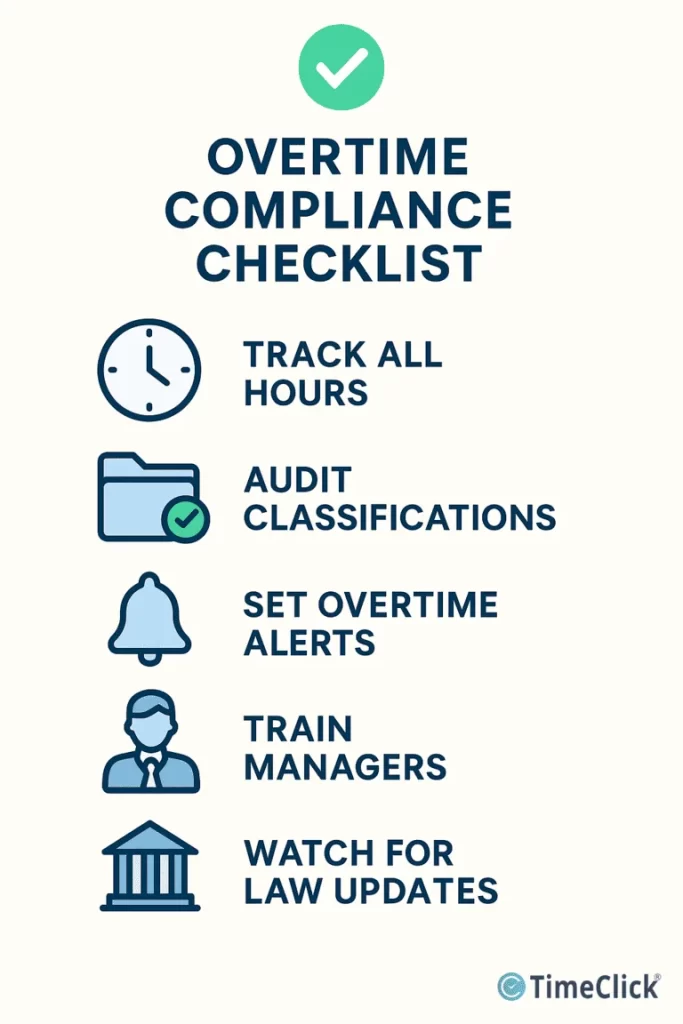
Staying compliant with overtime laws takes more than memorizing the rules. It comes down to having systems in place that catch problems early and keep payroll clean. Here’s how businesses usually stay on track:
- Track all hours worked: Make sure employees record every hour worked, including remote tasks, emails, and after-hours calls.
- Audit employee classifications: Review exempt and non-exempt status regularly to ensure it still aligns with salary thresholds and actual job duties.
- Monitor overtime thresholds: Use time tracking tools that alert you as employees get close to 40 hours in a workweek.
- Train managers and supervisors: Confirm that managers understand overtime rules and how scheduling decisions affect compliance.
- Stay updated on legal changes: Keep an eye on overtime rule changes at both the federal and state level through Department of Labor and local agency updates.
TIMECLICK TIP
TimeClick helps you catch overtime issues early with automatic alerts and clear, audit-ready records. Try our free Time Card Calculator to get a quick sense of how fast overtime costs can add up.
A proactive compliance system lowers legal risk and helps create a workplace where pay practices are clear, consistent, and trusted.
Frequently Asked Questions
Overtime rules raise a lot of questions, especially around salaried employees, bonuses, and how workweeks are defined. These are some of the questions employers ask most often.
Do I have to pay overtime to salaried employees?
Not always. Being salaried doesn’t automatically mean someone is exempt. Employees must meet both the salary threshold and the required job duties under the FLSA. If they don’t, overtime still applies for hours worked over 40 in a workweek.
What’s the difference between exempt and non-exempt employees?
Non-exempt employees must be paid overtime when they work more than 40 hours in a week. Exempt employees don’t receive overtime, but only if they meet specific salary and job duty requirements.
Does paid time off (PTO) count toward overtime?
No. Only hours actually worked count toward overtime. PTO, sick time, holidays, and vacation hours don’t factor into the 40-hour calculation. Our guide to whether PTO counts towards overtime covers the details.
Can I offer comp time instead of overtime pay?
In most cases, no. Private-sector employers are required to pay overtime wages rather than offer comp time, with only very limited exceptions.
How often should I review employee classifications?
At least once a year, and anytime an employee’s pay or job duties change. Regular check-ins help catch classification issues before they turn into bigger problems.
Final Tips for Overtime Compliance

Overtime compliance goes beyond avoiding fines. It helps keep schedules predictable, paychecks accurate, and trust intact between employers and employees.
With overtime lawsuits costing U.S. employers nearly half a billion dollars a year, proactive compliance is no longer optional. Regularly audit your employee classifications, track every hour worked, and monitor for approaching overtime thresholds.
Small steps now can save you from major penalties, public lawsuits, and brand damage later.
Track Hours Accurately with TimeClick
TimeClick helps you stay on top of overtime compliance without adding extra work. The system flags overtime risks automatically, keeps clean audit trails, and helps prevent costly payroll mistakes.
Ensure compliance, minimize risk, and treat your team right. Start your FREE 14-day TimeClick trial today and take the stress out of overtime tracking.
Start your FREE TimeClick Trial Today.