If you've ever stared at a timesheet full of hours and minutes trying to figure out what someone actually owes an employee, you know how quickly that math can go sideways. Clock-based time formats look straightforward on the surface, but they introduce a layer of complexity that makes accurate payroll calculations harder than they need to be.
Decimal hours solve that problem. Instead of working with two separate units — hours and minutes — everything gets expressed as a single number. That small change has a big impact on how cleanly, consistently, and accurately payroll gets calculated.
This article explains why decimal hours reduce payroll math problems, how they simplify rounding, and why modern payroll processes rely on them as a standard.
Table of Contents
- Why Traditional Clock Time Creates Payroll Math Problems
- How Decimal Hours Simplify Payroll Calculations
- Decimal Time Reduces Rounding Confusion
- Decimal Hours Make Payroll Easier to Audit
- Why Payroll Systems Rely on Decimal Hours
- How Decimal Time Improves Consistency Across Pay Periods
- When Manual Time Math Becomes Risky
- Frequently Asked Questions
- Build Payroll Math That Actually Works
Why Traditional Clock Time Creates Payroll Math Problems

Clock time reads naturally. Everyone understands that 8:45 means eight hours and forty-five minutes. But natural readability doesn't mean it's easy to calculate with.
When you're adding up a week's worth of clock-time entries, you run into a familiar problem: minutes don't follow base-10 math. There are 60 minutes in an hour, not 100. So when you add entries like 8:45, 7:50, and 8:30, you can't just stack those numbers the way you would with regular addition.
8:45 + 7:50 + 8:30 doesn't equal 24:125 — but that's the kind of error that happens when someone applies standard arithmetic to clock-based time.
You have to carry minutes into hours, track remainders, and constantly check whether a running total has crossed an hour threshold. That process works fine for simple entries, but across a full pay period with multiple employees, it becomes a source of ongoing inconsistency.
Common problems with manual clock-time math include:
- Adding minutes beyond 59 without converting to a new hour
- Miscounting total hours when minutes across entries don't align neatly
- Inconsistently handling partial hours during weekly totals
- Introducing small rounding errors that compound across employees and pay periods
These aren't always large mistakes. But even small discrepancies, repeated over time, create payroll records that are difficult to reconcile and harder to defend.
How Decimal Hours Simplify Payroll Calculations

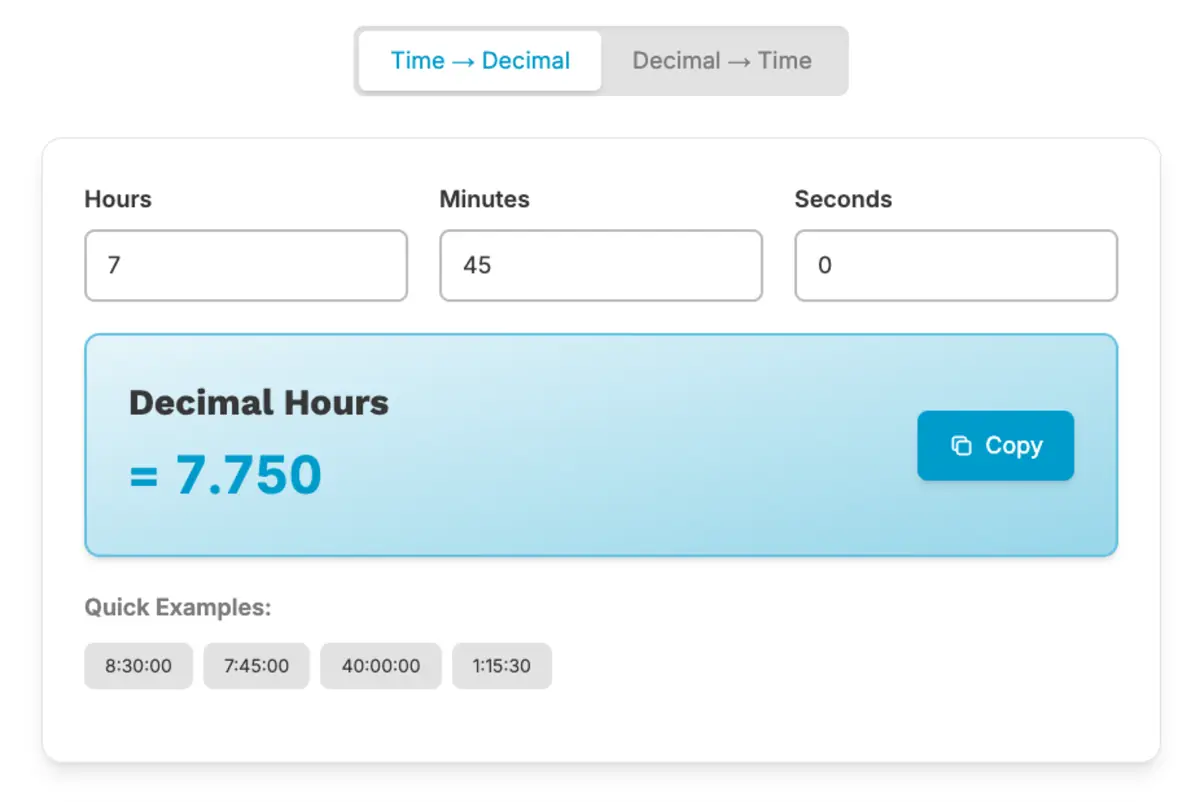
Decimal hours convert everything into a single number that follows standard math rules. Instead of 8 hours and 45 minutes, you work with 8.75. Instead of 7 hours and 30 minutes, you work with 7.5.
Once time is in decimal format, payroll math becomes much more straightforward:
- Addition works normally. 8.75 + 7.5 + 8.5 = 24.75. No carrying minutes, no conversions mid-calculation.
- Multiplication is direct. To calculate gross pay, you multiply total hours by the hourly rate. 24.75 hours x $18.00 = $445.50. That's it.
- Totals are easy to verify. A single decimal number is simple to spot-check against expected values.
The math doesn't require special handling. Decimal hours behave like any other number, which means fewer opportunities for calculation errors.
| Scenario | Clock Time Approach | Decimal Hours Approach |
|---|---|---|
| Adding three daily totals | 8:45 + 7:50 + 8:30 (requires minute conversion) | 8.75 + 7.83 + 8.50 = 25.08 |
| Calculating gross pay | Must convert total minutes first, then multiply | 25.08 x $18.00 = $451.44 |
| Verifying totals | Requires checking hour and minute columns separately | Single number, easy to cross-check |
| Identifying discrepancies | Harder to spot differences in mixed formats | Consistent format makes variances obvious |
Decimal Time Reduces Rounding Confusion

Rounding is where a lot of payroll disputes start. When time is tracked in clock format, partial minutes at the start or end of a shift often need to be rounded before they can be used in calculations. That rounding process can be inconsistent, especially when it's handled manually.
Under 29 CFR 785.48(b), rounding work time to the nearest 5 minutes, one-tenth of an hour, or quarter hour is permissible — but only when the rounding works both ways, meaning it must average out in employees' favor over time rather than consistently benefiting the employer.
That requirement matters. Rounding that always goes one direction creates compliance risk. But rounding that's inconsistent creates a different problem: records that don't agree with each other.
Decimal hours clarify this. When time is expressed in tenths of an hour, partial periods have a defined value. Six minutes equals 0.10. Fifteen minutes equals 0.25. Thirty minutes equals 0.50. There's no ambiguity about what a partial hour is worth because the math is built into the format.
This consistency does a few things for payroll:
- Reduces back-and-forth about what a partial shift period counts as
- Makes rounding practices easier to apply uniformly
- Provides a clear record of how time was calculated, which matters during audits or disputes
TIMECLICK TIP
When reviewing time records, check that partial-hour values are consistent across the pay period. If you see different decimal representations for the same duration in different entries, that's a signal that rounding isn't being applied uniformly.
Decimal Hours Make Payroll Easier to Audit

Auditing payroll is a lot easier when all the numbers are in the same format. Decimal hours create a consistent record that can be reviewed quickly and cross-checked without needing to convert between formats mid-review.
With clock-based time, an auditor or payroll administrator has to mentally translate entries to verify totals. A shift recorded as 7:48 has to be converted before it can be compared against a decimal-based payroll total. That translation step creates extra work and introduces the possibility of errors during review.
Decimal hours remove that friction. Every entry is already in the same format as the calculation output, so cross-checking involves straightforward comparison rather than conversion.
Practical benefits for payroll auditing include:
- Faster total verification. Decimal totals can be added and compared directly.
- Cleaner reporting. Records in a single format are easier to compile and present.
- Easier discrepancy identification. When all numbers use the same scale, an outlier is obvious.
- Reduced reconciliation time. Payroll teams spend less time translating formats and more time confirming accuracy.
This consistency also supports compliance. The U.S. Department of Labor's Fact Sheet #53 notes that accurate recordkeeping of hours worked is a core FLSA requirement — and records that are uniform, consistent, and clearly calculated are easier to demonstrate as accurate.
Why Payroll Systems Rely on Decimal Hours
There's a reason modern payroll software doesn't process time in hours and minutes. Calculations that run automatically need a format that works with standard arithmetic. Decimal hours are that format.
When a payroll system takes an employee's hours and multiplies by a wage rate to generate a gross pay figure, it needs a single, clean number. Decimal hours provide that. Clock-based entries would require a conversion layer before any calculation could happen, adding complexity and potential failure points.
Standardizing on decimal hours also means that data exported from time tracking systems, imported into payroll software, and used in financial reporting all speaks the same language. No reformatting required. No manual adjustments between steps.
That standardization is especially important when multiple employees are being processed at once. Consistency at the data level means the payroll engine can apply the same logic to every record without exception handling for format differences.
How Decimal Time Improves Consistency Across Pay Periods

One of the quieter benefits of decimal hours is how they reduce variation from one pay period to the next. When time is calculated in clock format manually, the output can vary depending on who's doing the calculation and how they handle edge cases. Decimal hours reduce that variability.
Here's why consistency matters:
- Predictable totals. When the same hours produce the same decimal value every time, payroll totals are easier to forecast and verify.
- Fewer rounding discrepancies. A standardized decimal format means partial hours are represented the same way across all records.
- Simpler period-over-period comparison. When every pay period uses the same format, comparing totals across weeks or months is straightforward.
- Less administrative back-and-forth. Consistent records mean fewer corrections after the fact.
Over time, this consistency compounds. Payroll teams spend less time reconciling discrepancies and more time confirming that records are accurate — a much better use of everyone's effort.

Even with decimal hours, errors can still happen. Learn how to spot and fix the most common ones with our guide: Common Decimal Time Conversion Mistakes to Avoid
When Manual Time Math Becomes Risky

Manual payroll calculations aren't inherently wrong, but they carry more risk as complexity increases. The more employees you have, the longer the pay period, and the more variation in schedules, the more opportunities there are for small errors to accumulate.
With clock-based time and manual math, that risk is higher because each calculation step requires a format conversion that can introduce mistakes. A mis-added minute total, a missed carry, or an inconsistently applied rounding rule can mean an employee is slightly underpaid — or that overtime calculations are off.
Decimal hours reduce that risk by simplifying the math at every step. But even with a cleaner format, manual calculations still rely on consistent human execution. When volume or complexity grows beyond what manual processes handle well, the answer isn't just a better format — it's removing the manual step entirely.
See how automation removes the manual step and keeps payroll calculations consistent: How Automated Decimal Conversion Reduces Payroll Risk
Frequently Asked Questions
Here are answers to some of the most common questions about decimal hours and payroll accuracy.
Are decimal hours more accurate than minutes?
Decimal hours aren't more accurate in terms of time measurement, but they're easier to calculate with accurately. Because they follow standard base-10 math, addition and multiplication work without conversion steps. That reduces the opportunity for calculation errors compared to working with hours and minutes separately.
Why do payroll systems use decimal time?
Payroll systems use decimal time because it's compatible with standard arithmetic. When software multiplies hours by a wage rate, it needs a single number — not a two-part hours-and-minutes value. Decimal hours provide that, and they also make it easier to integrate data between time tracking and payroll platforms without format conversion.
Can decimal hours reduce payroll errors?
Yes. Decimal hours reduce a specific category of payroll errors: those caused by base-60 arithmetic mistakes. When you remove the need to manually convert minutes into fractions of an hour, you eliminate one of the most common sources of small calculation errors in manual payroll processing.
Is decimal time easier to audit?
Generally, yes. A consistent decimal format means every record uses the same scale, which makes cross-checking totals straightforward. Auditors and payroll administrators can verify calculations without needing to translate between clock time and decimal format, reducing review time and the chance of catching something wrong during translation rather than the original record.
Build Payroll Math That Actually Works
Decimal hours don't fix every payroll challenge, but they solve a specific and common one: the inconsistency that comes from doing base-60 math manually. A single number format, consistent rounding, and straightforward multiplication make payroll calculations cleaner at every step.
If your current process involves converting clock time entries before you can calculate totals, that's a sign that your format is adding work rather than reducing it. Switching to decimal hours removes that extra step and gives you a more reliable foundation for accurate payroll.
Not using TimeClick yet? Try our time clock software free. 10-minute setup, unlimited users, and built for small businesses. No credit card required.
Start your FREE TimeClick Trial Today.