Picture this: you've just finished payroll for the week. Everything looks good. Then, a few days later, you realize one of your employees was paid for 45 minutes less than they actually worked — not because of bad intentions, but because someone entered .45 instead of .75. That one small decimal time conversion mistake quietly shorted a real person real wages.
Decimal time conversion isn't rocket science. The math is straightforward. But these errors happen constantly, and they're easy to miss because the numbers often look close enough to right. A little under here, a little over there — and before you know it, you've got a payroll discrepancy you have to untangle.

This post walks through the most common decimal time conversion mistakes, why they happen, and what to do instead. If you're looking for a full step-by-step walkthrough on how the conversion math actually works, check out our How to Convert Time Cards Into Decimal Hours guide
Table of Contents
- Why Small Mistakes Add Up Fast
- Mistake #1: Confusing .45 With .75
- Mistake #2: Rounding the Wrong Way
- Mistake #3: Forgetting to Deduct Unpaid Breaks
- Mistake #4: Entering Raw Minutes as Decimal Values
- Mistake #5: Inconsistent Rounding Across the Team
- A Quick Reference: Common Decimal Conversion Values
- How to Avoid These Mistakes Going Forward
- Frequently Asked Questions
- Clean Up the Math Before It Costs You
Why Small Mistakes Add Up Fast

A single incorrect entry might only affect a few minutes of pay. But multiply that across a team of 10 or 15 employees, over two pay periods a month, and small errors compound into something that can affect both your budget and your compliance standing. Even a consistent 15-minute error per employee adds up to hours of miscalculated wages over time.
The goal isn't to make payroll more stressful. It's the opposite — once you know where these mistakes come from, they become a lot easier to prevent.
Mistake #1: Confusing .45 With .75
This is the most common decimal time conversion mistake, and it's also the most damaging. Here's what happens: someone needs to convert 45 minutes into a decimal, and instead of doing the math, they just write .45. It feels intuitive. But it's wrong.
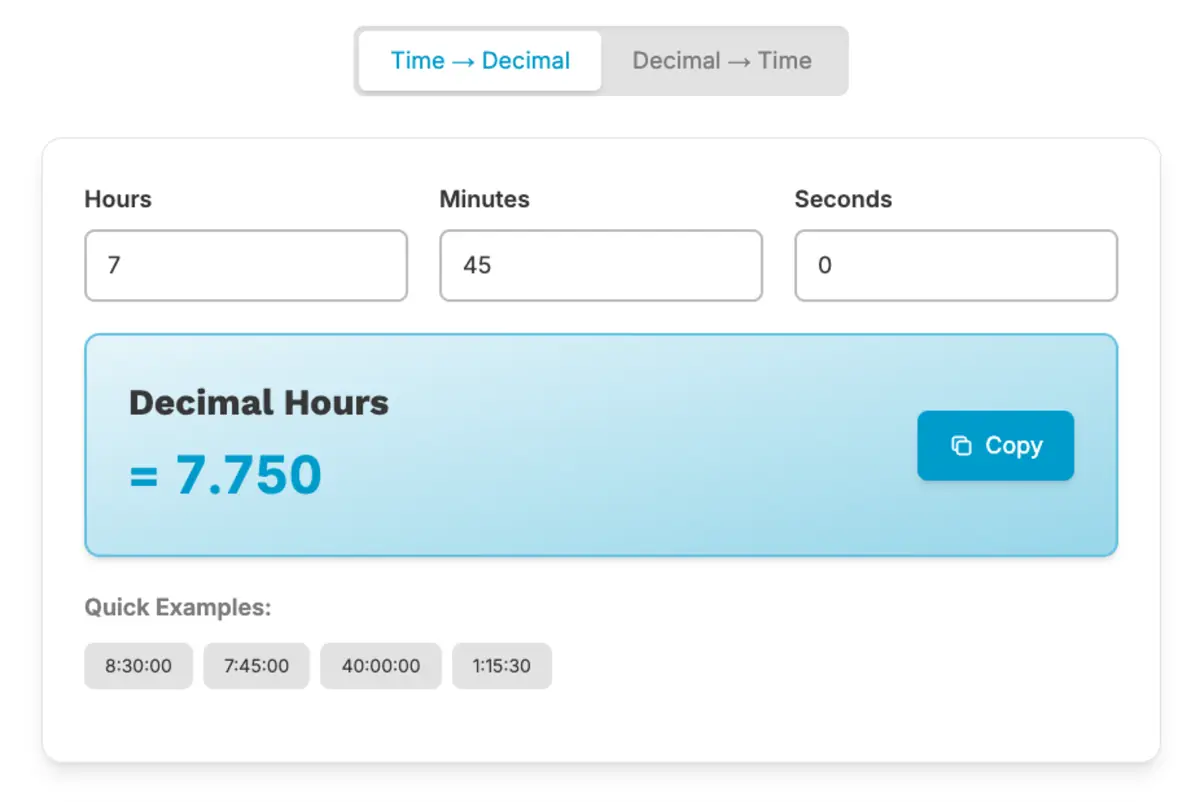
To convert minutes to decimal hours, you divide by 60. So 45 minutes becomes 45 ÷ 60 = .75, not .45.
- ❌ Wrong: Employee worked 8 hours 45 minutes → entered as 8.45
- ✅ Correct: 45 ÷ 60 = .75 → should be entered as 8.75
Here's the thing that makes this extra confusing: .45 is actually a valid decimal time value. It's the correct decimal for 27 minutes (27 ÷ 60 = 0.45). So the number isn't made up — it just doesn't mean what most people assume it means.
Here are some commonly confused minute-to-decimal values, pulled from the NC Department of Labor Time Conversion Chart:
| Minutes | Decimal Hours |
|---|---|
| 15 min | .25 |
| 27 min | .45 |
| 30 min | .50 |
| 40 min | .67 |
| 45 min | .75 |
| 50 min | .83 |
Notice how different 45 minutes (.75) and .45 (27 minutes) really are. That gap — 18 minutes of missed pay — can add up quickly across a full team.
Mistake #2: Rounding the Wrong Way

Rounding time isn't just a preference — there are actual federal rules governing how it works. Under U.S. Department of Labor guidance and 29 CFR 785.48(b), employers may round employee time to the nearest quarter hour. But here's the key requirement: rounding must be neutral. Consistently rounding down in the employer's favor is a wage violation under the FLSA.
The standard rule, often called the 7-minute rule, works like this:
- 1–7 minutes over a quarter hour: may be rounded down
- 8–14 minutes over a quarter hour: must be rounded up to the next quarter hour
- ❌ Wrong: Employee clocks out at 5:08 PM — employer rounds to 5:00 PM every time
- ✅ Correct: 5:08 PM rounds up to 5:15 PM (8 minutes over = round up)
The problem isn't that employers are always trying to shortchange people. Often, it's just habit — someone rounds down out of convenience without realizing they're doing it every single time. A clear, written rounding policy prevents that.
TIMECLICK TIP
TimeClick applies rounding rules consistently across every employee, every punch. No guesswork, no habit-based decisions — just clean, rule-based rounding every time.
Mistake #3: Forgetting to Deduct Unpaid Breaks

A lot of manual time entries track total clock time from punch-in to punch-out without subtracting unpaid break periods. The result? Employees appear to have worked more hours than they actually did, and payroll gets miscalculated in their favor — which sounds nice until you're audited or realize it's been happening for months.
- ❌ Wrong: Employee clocks 9:00 AM to 5:30 PM = 8.50 hours entered into payroll as-is
- ✅ Correct: Subtract 30-minute unpaid lunch = 8.00 payable hours
One important distinction: short paid breaks should not be deducted. Per DOL regulations (29 CFR 785.18), rest periods of short duration — generally 5 to about 20 minutes — are considered work time and must be counted as hours worked. Only unpaid meal breaks of 30 minutes or more qualify as non-work time, and only when the employee is completely relieved from duty (29 CFR 785.19).
So the rule of thumb is: paid short break? Keep it in. Unpaid meal break with full relief from duty? Deduct it.
Mistake #4: Entering Raw Minutes as Decimal Values

This one is similar to Mistake #1 but distinct enough to call out on its own. It happens when someone copies the clock minutes directly into a decimal field — no math, just the raw number.
- Employee worked 7 hours and 40 minutes
- ❌ Wrong: Someone types 7.40 into the payroll system
- ✅ Correct: 40 ÷ 60 = .67 → should be entered as 7.67
Here's why this mistake is tricky: 7.40 and 7.67 look close. They're in the same ballpark. The error is small enough that it often goes unnoticed until an audit surfaces it — or until an employee raises the discrepancy. Always divide minutes by 60. No exceptions, no shortcuts.
Mistake #5: Inconsistent Rounding Across the Team

This last mistake is less about math and more about consistency. Some managers round one employee's time up and another's down based on memory or personal habit rather than a standard policy. Over time, that inconsistency creates two problems: compliance exposure and the appearance of favoritism.
The fix is simple in theory: apply the same rounding rule to every employee, every time. But simple in theory doesn't always mean simple in practice, especially if you're managing multiple departments or have several people entering time data.
A written rounding policy that everyone follows is your best line of defense. If you want to go deeper on the conversion math itself, checkout our step-by-step decimal time conversion guide
A Quick Reference: Common Decimal Conversion Values
If you're doing manual conversions, bookmark this table. It covers all 60 minutes and their decimal equivalents, sourced directly from the NC Department of Labor Time Conversion Chart.
| Minutes | Decimal Hours | Minutes | Decimal Hours |
|---|---|---|---|
| 1 | .02 | 16 | .27 |
| 2 | .03 | 17 | .28 |
| 3 | .05 | 18 | .30 |
| 4 | .07 | 19 | .32 |
| 5 | .08 | 20 | .33 |
| 6 | .10 | 21 | .35 |
| 7 | .12 | 22 | .37 |
| 8 | .13 | 23 | .38 |
| 9 | .15 | 24 | .40 |
| 10 | .17 | 25 | .42 |
| 11 | .18 | 26 | .43 |
| 12 | .20 | 27 | .45 |
| 13 | .22 | 28 | .47 |
| 14 | .23 | 29 | .48 |
| 15 | .25 | 30 | .50 |
| 31 | .52 | 46 | .77 |
| 32 | .53 | 47 | .78 |
| 33 | .55 | 48 | .80 |
| 34 | .57 | 49 | .82 |
| 35 | .58 | 50 | .83 |
| 36 | .60 | 51 | .85 |
| 37 | .62 | 52 | .87 |
| 38 | .63 | 53 | .88 |
| 39 | .65 | 54 | .90 |
| 40 | .67 | 55 | .92 |
| 41 | .68 | 56 | .93 |
| 42 | .70 | 57 | .95 |
| 43 | .72 | 58 | .97 |
| 44 | .73 | 59 | .98 |
| 45 | .75 | 60 | 1.0 |
TIMECLICK TIP
TimeClick automatically converts punched time into decimal hours — no chart needed, no manual math. Your payroll-ready decimal totals are calculated for you every time.
How to Avoid These Mistakes Going Forward
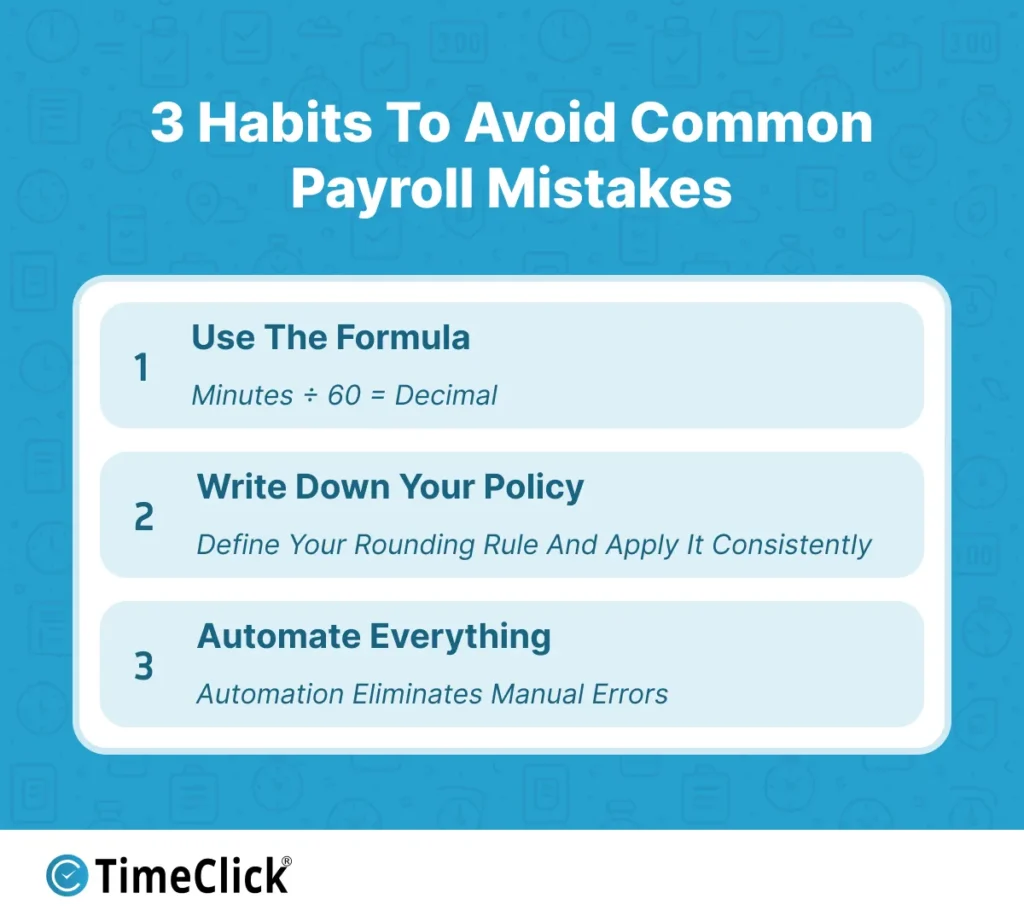
The good news: every mistake on this list is preventable. Here are three habits that make a real difference.
- Always use the division formula. Minutes ÷ 60 = decimal. Every time, no exceptions. Don't rely on memory or intuition for specific values.
- Write your rounding policy down. Spell out exactly which rule you follow (such as the 7-minute rule) and apply it consistently to every employee on every shift.
- Automate where you can. Manual conversion is where almost all of these errors originate. When the math is handled automatically, there's nothing to misremember or mistype.
If you want to build a stronger foundation in the math itself, checkout our How to Convert Time Cards Into Decimal Hours
Frequently Asked Questions
Still have questions about decimal time conversion mistakes? Here are answers to some of the most common ones.
What is the most common decimal time conversion mistake?
The most common mistake is entering the raw minute value as a decimal instead of dividing by 60. For example, writing 8.45 for 8 hours and 45 minutes instead of the correct 8.75. It feels intuitive, but it produces a meaningfully different — and incorrect — result.
Is .45 ever a correct decimal time value?
Yes. The decimal .45 is the correct value for 27 minutes (27 ÷ 60 = 0.45). The confusion happens when people assume .45 represents 45 minutes — it doesn't. Always do the math rather than assuming the decimal matches the minute number.
What does the FLSA say about time rounding?
The U.S. Department of Labor allows employers to round employee time to the nearest quarter hour, but rounding must be applied neutrally. Under the standard 7-minute rule, time from 1–7 minutes over a quarter hour can be rounded down, but time from 8–14 minutes must be rounded up. Consistently rounding down in the employer's favor is a wage violation under the FLSA. See 29 CFR 785.48(b) for the full regulatory language.
Do I need to deduct paid breaks from decimal hours?
No. Short paid breaks — generally under 20 minutes — are classified as work time under federal regulations (29 CFR 785.18) and should be included in your total. Only unpaid meal breaks of 30 minutes or more should be deducted, and only when the employee is fully relieved from all duties during that time (29 CFR 785.19).
What's the easiest way to avoid decimal time conversion errors?
The most reliable approach is automating the conversion through a time tracking system so there's no manual math involved. If you're doing it manually, always divide minutes by 60 and verify your entries before they go into payroll. Keeping a reference chart close by — like the full 60-minute table above — also helps catch mistakes before they become problems.
Clean Up the Math Before It Costs You
Five mistakes, all of them common, all of them fixable. To recap: confusing .45 with .75, rounding in the employer's favor every time, failing to deduct unpaid meal breaks, entering raw minutes as decimal values, and applying different rounding rules to different employees.
None of these errors happen because someone is careless. They happen because the math looks close enough to right until you check it carefully. The fix isn't to stress over every entry — it's to know where the traps are and build habits that sidestep them.
For a deeper look at the conversion math itself, checkout our How to Convert Time Cards Into Decimal Hours guide
And if you'd rather skip the manual math altogether, TimeClick handles decimal conversion automatically — so your time totals are always accurate and payroll-ready without any extra effort on your end.
Not using TimeClick yet? Try our time clock software free. 10-minute setup, unlimited users, and built for small businesses. No credit card required.
Start your FREE TimeClick Trial Today.