
Labor Laws by State: What Employers Need to Know
Last updated:
Federal law sets the floor for pay, overtime and records. States add their own rules on top, and when the two differ, the rule that’s better for the employee usually applies. This page puts the main state rules for small employers in one table, with a link to the state agency for each one and the date we last checked it.
This page is general information and isn’t legal advice. Laws change, so check the linked state agency before you act.
- 14-day free trial
- No credit card required
- Set up in 10 minutes or less

Find your state
Show the full table
| State | Minimum wage | Daily overtime | Meal break for adults | Rest breaks for adults | Final paycheck deadline | Unused PTO paid at termination | Paid sick leave law | State agency | Last checked |
|---|---|---|---|---|---|---|---|---|---|
| Alabama | No state law; federal $7.25 | None | None | None | No state law | No state law | No | Alabama Department of Workforce | Nov 8, 2026 |
| Alaska | $14.00 (2027: $15.00 on July 1, 2027) | After 8 hrs | None | None | Fired: within 3 working days. Quit: next regular payday at least 3 working days after the last day | Only if the employer promised it | Yes: at least 1 hr per 30 hrs worked | Alaska Dept. of Labor and Workforce Development | Nov 14, 2026 |
| Arizona | $15.15 (2027: $15.65 from Jan 1, 2027) | None | None | None | Fired: within 7 working days or end of the next regular pay period, whichever is sooner. Quit: regular payday for the pay period of the quit | We found no state rule. Check with the state agency. | Yes: 1 hr per 30 hrs; up to 40 hrs a year (15+ employees) or 24 hrs (under 15) | Industrial Commission of Arizona | Nov 8, 2026 |
| Arkansas | $11.00 (employers with 4+ employees) | None | None | None | Fired by a company or corporation: next regular payday. Quit: we found no state rule. Check with the state agency. | Agency asks for a company policy promising it; no state payout rule stated | No | Arkansas Dept. of Labor and Licensing | Nov 8, 2026 |
| California | $16.90 (2027: $17.40 on Jan 1, 2027) | After 8 hrs (double time after 12 hrs) | 30 min if over 5 hrs; second 30 min if over 10 hrs | Paid 10 min per 4 hrs | Fired: immediately. Quit with 72 hrs notice: last day. Quit without notice: within 72 hrs | Yes: all earned unused vacation; use-it-or-lose-it not allowed | Yes: up to 40 hrs a year | California Labor Commissioner (DIR) | Nov 8, 2026 |
| Colorado | $15.16 (2027: $15.71) | After 12 hrs | 30 min if shift is over 5 consecutive hrs | Paid 10 min per 4 hrs | Fired: immediately (set extra time if payroll is closed). Quit: next regular payday | Yes: all earned vacation pay | Yes: up to 48 hrs a year | Colorado Dept. of Labor and Employment | Nov 8, 2026 |
| Connecticut | $16.94 | None | 30 min for 7.5+ consecutive hrs, after the first 2 hrs and before the last 2 hrs | None | Fired: next business day. Quit: next regular payday | Only if employer policy or union contract provides it | Yes: up to 40 hrs a year; employers with 11+ employees in 2026, all employers in 2027 | Connecticut Dept. of Labor | Nov 8, 2026 |
| Delaware | $15.00 | None | 30 min unpaid for 7.5+ consecutive hrs, after the first 2 hrs and before the last 2 hrs | None | Any separation: next regular payday or 3 business days after the last day, whichever is later | Agency asks for the employer’s policy for vacation pay claims; no state payout rule stated | No | Delaware Dept. of Labor, Office of Labor Law Enforcement | Nov 14, 2026 |
| District of Columbia | $18.40 (adjusted each July 1) | None | None | None | Fired: next working day. Quit: next regular payday or 7 days, whichever is earlier | Not required; follows the employer’s vacation policy | Yes: 24 to 56 hrs a year by employer size | DC Dept. of Employment Services, Office of Wage-Hour | Nov 8, 2026 |
| Florida | $15.00 (since Sept 30, 2026) | None | None | None | We found no state rule. Check with the state agency. | We found no state rule. Check with the state agency. | No | U.S. DOL (Florida has no state labor department for wage claims) | Nov 8, 2026 |
| Georgia | $5.15 state rate (employers with 6+ employees); federal $7.25 for covered employers | None | None | None | We found no state rule. Check with the state agency. | No state law requires vacation or sick leave; no state payout rule stated | No | Georgia Dept. of Labor | Nov 14, 2026 |
| Hawaii | $16.00 | None | None | None | Fired: at discharge or next working day. Quit: next regular payday (last day if one pay period notice) | No state law requires paid vacation; the employer’s written policy sets the rules | No | Hawaii Dept. of Labor, Wage Standards Division | Nov 14, 2026 |
| Idaho | $7.25 | None | None | None | Next regular payday or within 10 days (weekends and holidays excluded), whichever is earlier | Not required by state law; payout at separation not addressed | No | Idaho Dept. of Labor | Nov 8, 2026 |
| Illinois | $15.00 (employers with 4+ employees) | None | 20 min by the 5th hr for 7.5+ continuous hrs | None (hotel room attendants in Cook County only) | No later than the next regular payday, fired or quit | Yes: all earned vacation; use-it-or-lose-it allowed with notice | Paid leave for any reason: 1 hr per 40 hrs, up to 40 hrs a year, all employers | Illinois Dept. of Labor | Nov 8, 2026 |
| Indiana | $7.25 (employers with 2+ employees) | None | None | None | Quit: next regular payday. Let go by employer: regular payday for the pay period of separation | Yes, accrued vacation is compensation; employer policy or contract conditions apply | No | Indiana Dept. of Labor (Indiana Code 22-2) | Nov 14, 2026 |
| Iowa | $7.25 | None | None | None | Next regular payday | Depends on the employer’s agreement or policy | No | Iowa Labor Commissioner (Iowa Code 91A) | Nov 8, 2026 |
| Kansas | $7.25 | None | None | None | Next regular payday, fired or quit | Only if the employer’s policy or contract provides it | No | Kansas Dept. of Labor (K.S.A. 44-315) | Nov 14, 2026 |
| Kentucky | $7.25 | None | Meal period between the 3rd and 5th hr; unpaid if duty-free | Paid 10 min per 4 hrs | Next regular payday or 14 days, whichever is later | Yes, vested vacation pay counts as wages and is due with final pay | No | Kentucky Education and Labor Cabinet | Nov 14, 2026 |
| Louisiana | No state law; federal $7.25 | None | None | None | Next regular payday or 15 days, whichever comes first | Yes: vacation earned under the employer’s policy can’t be forfeited | No | Louisiana Workforce Commission (La. R.S. 23:631) | Nov 8, 2026 |
| Maine | $15.10 (2027: $15.70 on Jan 1, 2027) | None | 30 min (paid or unpaid) after 6 consecutive hrs | None | Next established payday | Yes for vacation accrued since Jan 1, 2023, except employers with 10 or fewer employees | Earned paid leave for any reason: up to 40 hrs | Maine Dept. of Labor | Nov 8, 2026 |
| Maryland | $15.00 | None | Retail only: 15 min for 4 to 6 hrs; 30 min for over 6 hrs | None | On or before the regular payday | Yes, unless a written policy given at hiring says unused vacation is lost | Yes: employers with 15+ employees; accrue up to 40 hrs a year | Maryland Dept. of Labor | Nov 8, 2026 |
| Massachusetts | $15.00 | None | 30 min per 6 hrs | None | Fired: day of discharge. Quit: next regular payday | Yes: accrued vacation goes in the final paycheck | Yes: employers with 11+ employees; up to 40 hrs a year | Massachusetts Attorney General / Mass.gov | Nov 8, 2026 |
| Michigan | $13.73 (2027: $15.00 on Jan 1, 2027) | None | None | None | Regular payday for the pay period of the quit or discharge | Only if a written policy or contract provides it | Yes: all employers since Feb 21, 2025; yearly cap depends on employer size | Michigan LEO, Wage and Hour Division | Nov 8, 2026 |
| Minnesota | $11.41 (2027: $11.87 on Jan 1, 2027) | None | 30 min for 6+ consecutive hrs (since Jan 1, 2026) | Paid 15 min per 4 consecutive hrs (since Jan 1, 2026) | Fired: within 24 hrs of the employee’s demand. Quit: first payday more than 5 days after quitting; no later than 20 days | Company policy decides | Yes: up to 48 hrs a year | Minnesota Dept. of Labor and Industry | Nov 8, 2026 |
| Mississippi | No state law; federal $7.25 | None | None | None | We found no state rule. Check with the state agency. | We found no state rule. Check with the state agency. | No | U.S. DOL (Mississippi has no state wage and hour agency) | Nov 8, 2026 |
| Missouri | $15.00 | None | None | None | Fired: at the time of termination. Quit: no state law | Not required unless a contract sets it | No (requirement ended Aug 28, 2025) | Missouri Dept. of Labor | Nov 14, 2026 |
| Montana | $10.85 (2027: $11.20 on Jan 1, 2027) | None | None | None | Fired or laid off: immediately, within 4 hrs or end of business day (unless written policy extends). Quit: next scheduled payday or 15 days, whichever is first | Earned vacation counts as wages | No | Montana Dept. of Labor and Industry | Nov 8, 2026 |
| Nebraska | $15.00 (employers with 4+ employees) | None | 30 min per 8-hr shift, only in assembly plants, workshops and mechanical businesses | None | Next regular payday or 2 weeks after termination, whichever is sooner | Yes: earned unused vacation or PTO | Yes: employers with 11+ employees; 1 hr per 30 hrs, up to 40 hrs (11 to 19 employees) or 56 hrs (20+) | Nebraska Dept. of Labor | Nov 8, 2026 |
| Nevada | $12.00 | After 8 hrs in 24 hrs, only for employees paid under 1.5 times the state minimum | 30 min unpaid per 8 hrs | Paid 10 min per 4 hrs | Fired: immediately. Quit: within 7 days or next regular payday, whichever is earlier | Not required for state paid leave (NRS 608.0197); employer may choose to pay it | Paid leave for any reason, employers with 50+ employees: 0.01923 hr per hr worked | Nevada Labor Commissioner | Nov 14, 2026 |
| New Hampshire | $7.25 | None | 30 min after 5 consecutive hrs, unless eating while working is allowed | None | Fired: within 72 hrs. Quit: next regular payday (72 hrs if one pay period notice) | Yes, if part of the employer’s policy or practice: vacation pay counts as wages when due | No | New Hampshire Dept. of Labor (RSA 275:44) | Nov 14, 2026 |
| New Jersey | $15.92; $15.23 small and seasonal employers (2027: $16.48; $16.25 small and seasonal) | None | None | None | Next regular payday, fired or quit | Not required by state law; follows the employer’s policy | Yes: 1 hr per 30 hrs, up to 40 hrs a year | New Jersey Dept. of Labor and Workforce Development | Nov 8, 2026 |
| New Mexico | $12.00 | None | None | None | Fired: within 5 days (fixed pay) or 10 days (task, piece or commission pay). Quit: next regular payday | We found no state rule. Check with the state agency. | Yes: up to 64 hrs a year | New Mexico Dept. of Workforce Solutions | Nov 14, 2026 |
| New York | $17.00 NYC, Long Island, Westchester; $16.00 rest of state (2027: no change) | None | 30 min midday for shifts over 6 hrs (1 hr in factories); extra rules for long and night shifts | None | No later than the regular payday for the last pay period | Only if promised; no claim if a written policy excludes payout | Yes: 40 hrs a year (5 to 99 employees) or 56 hrs (100+) | New York State Dept. of Labor | Nov 8, 2026 |
| North Carolina | $7.25 | None | None | None | Next regular payday, any reason | Yes, unless a written forfeiture clause applies | No | North Carolina Dept. of Labor | Nov 8, 2026 |
| North Dakota | $7.25 | None | 30 min per shift over 5 hrs when 2+ employees are on duty | None | Next regular payday, any separation | Yes, with a narrow exception for voluntary quits | No | North Dakota Dept. of Labor and Human Rights | Nov 8, 2026 |
| Ohio | $11.00 (gross receipts $405,000+); $7.25 smaller employers (2027: $11.40, threshold $419,000) | None | None | None | No separate final pay rule in Ohio’s pay law (ORC 4113.15) | We found no state rule. Check with the state agency. | No | Ohio Dept. of Commerce, Wage and Hour | Nov 8, 2026 |
| Oklahoma | $7.25 (10+ full-time employees or over $100,000 sales); $2.00 others | None | None | None | Next regular payday for the pay period | Only if a written policy or contract promises cash in lieu, or a documented practice | No | Oklahoma Dept. of Labor | Nov 8, 2026 |
| Oregon | $15.55 standard; $16.80 Portland metro; $14.55 nonurban (adjusted each July 1) | After 10 hrs, only in some manufacturing and canning settings | 30 min for 6 to 8 hr work periods | Paid 10 min per 4 hrs | Fired or laid off: end of next business day. Quit with 48 hrs notice: last day. Quit without: 5 business days or next regular payday, whichever is first | Not required; employer must honor its policy | Yes: employers with 10+ employees; up to 40 hrs a year | Oregon Bureau of Labor and Industries | Nov 8, 2026 |
| Pennsylvania | $7.25 | None | None (seasonal farm workers only) | None | Fired or quit: next regular payday | Only if the employer’s policy or agreement provides it; vacation pay is a fringe benefit under state wage law | No | Pennsylvania Dept. of Labor and Industry | Nov 14, 2026 |
| Rhode Island | $16.00 | None | 20 min in a 6-hr shift; 30 min in an 8-hr shift (not for under 3 employees on site) | None | Next regular payday (24 hrs if the business closes, merges or leaves the state) | Yes after 1 year of service | Yes: 1 hr per 35 hrs, up to 40 hrs; paid at 18+ employees, unpaid below 18 | Rhode Island Dept. of Labor and Training | Nov 8, 2026 |
| South Carolina | No state law; federal $7.25 | None | None | None | Within 48 hrs or the next regular payday, not more than 30 days | Depends on company policy | No | South Carolina LLR, Office of Wages | Nov 8, 2026 |
| South Dakota | $11.85 (2027: $12.30) | None | None | None | Next regular payday (or when employer property is returned) | No state law requires paid leave; matter of employer policy | No | South Dakota Dept. of Labor and Regulation | Nov 14, 2026 |
| Tennessee | No state law; federal $7.25 | None | 30 min unpaid if scheduled 6 consecutive hrs | None | Next regular payday or 21 days, whichever is later | Only if policy or labor agreement requires it | No | Tennessee Dept. of Labor and Workforce Development | Nov 8, 2026 |
| Texas | $7.25 | None | None | None | Fired or laid off: within 6 calendar days. Quit: next regular payday | Only if promised in a written policy or agreement | No | Texas Workforce Commission | Nov 8, 2026 |
| Utah | $7.25 | None | None | None | Fired: within 24 hrs. Quit: next regular payday | Not required; employer must follow its policy | No | Utah Labor Commission | Nov 8, 2026 |
| Vermont | $14.42 (employers with 2+ employees) | None | Reasonable opportunity to eat and use the toilet | Reasonable opportunity to eat and use the toilet | Fired: within 72 hrs. Quit: last regular payday (following Friday if none) | Not required unless a written agreement or handbook provides it | Yes: up to 40 hrs a year | Vermont Dept. of Labor | Nov 8, 2026 |
| Virginia | $12.77 | None | None | None | On or before the date wages would have been paid | No state payout rule; the state treats vacation and PTO as fringe benefits, not wages | Home health workers now; all employers phased in: 50+ employees July 1, 2027, 25+ Jan 1, 2028, all Jan 1, 2029 (1 hr per 30 hrs, up to 40 hrs) | Virginia Dept. of Labor and Industry (Code of Virginia) | Nov 14, 2026 |
| Washington | $17.13 (2027: $17.73 on Jan 1, 2027) | None | 30 min for over 5 hrs, between the 2nd and 5th hr | Paid 10 min per 4 hrs | Next regular payday, fired or quit | Not required (voluntary benefit) | Yes: all employers; no yearly cap | Washington Dept. of Labor and Industries | Nov 8, 2026 |
| West Virginia | $8.75 (employers with 6+ employees at one location) | None | 20 min for 6+ hrs | None | Next regular payday, fired, laid off or quit | Accrued vacation that can be calculated counts as wages due | No | West Virginia Division of Labor | Nov 8, 2026 |
| Wisconsin | $7.25 | None | None (30 min after 6 hrs recommended only) | None | Regular pay schedule, any reason | Yes if there is a written vacation policy without a written forfeiture policy | No | Wisconsin Dept. of Workforce Development | Nov 8, 2026 |
| Wyoming | $5.15 state rate; federal $7.25 for covered employers | None | None | None | Next regular payday | Only if policy or promise | No | Wyoming Dept. of Workforce Services | Nov 8, 2026 |
Sources for the table: DOL state minimum wage laws (minimum wage and daily overtime, page updated Nov 5, 2026), DOL state meal period table and DOL state rest period table (both dated Jan 1, 2023, so newer state changes such as Minnesota’s 2026 break law come from the state agency), the DOL Women’s Bureau paid leave page (as of December 2024, updated from state agencies for later changes), and each state’s labor agency for final pay, PTO payout and 2027 minimum wage rates. 2027 rates are listed only where the state agency has published them. Some states also have city or county minimum wages and sick leave laws that aren’t shown here.
Federal labor laws every employer follows
- Minimum wage and overtime. The Fair Labor Standards Act sets the federal minimum wage and requires time and a half for non-exempt employees after 40 hours in a workweek. See the overtime laws guide and the federal overtime salary threshold.
- Time records. Employers must keep records of hours worked and pay for non-exempt employees. See are you required to track employee time.
- Child labor. Federal rules limit the hours and jobs of workers under 18. See the child labor laws guide.
- Family and medical leave. The FMLA applies to employers with 50 or more employees. See FMLA rules by state.
- Employee rights. A summary of what workers are entitled to is in the employee rights guide.
For the latest back wage, overtime and child labor numbers from the Department of Labor, see our wage and hour statistics.
Breaks and meal periods by state
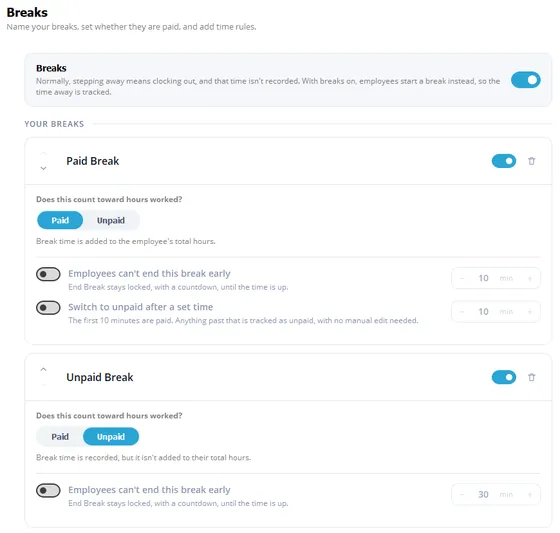
Federal law doesn’t require meal or rest breaks for adults. When an employer gives short breaks, usually 5 to 20 minutes, federal rules count them as paid work time. Many states go further and require a meal period after a set number of hours, and a few require paid rest breaks. The state-by-state rules, with minutes and timing, are in the break laws by state guide.
Overtime rules by state
Most states follow the federal 40-hour weekly rule. A few also require overtime after a set number of hours in a day, California being the best known. See the overtime laws guide and California overtime laws.
Minimum wage and tipped wage by state
Many states set a minimum wage above the federal rate, and several raise it each January. Tipped minimum wages vary even more. See tipped minimum wage by state.
PTO, sick leave and holiday pay by state
Federal law doesn’t require paid vacation, sick leave or holidays. States set rules on accrual, use-it-or-lose-it policies and payout when someone leaves, and a growing number require paid sick leave.
Final paychecks and termination rules by state
Federal law doesn’t set a deadline for a final paycheck. States do, and some require payment on the last day of work. See the termination laws guide.
Hiring minors by state
States add their own limits on hours, night work and work permits for minors. See the child labor laws guide.
Classifying employees correctly
Whether someone is exempt or non-exempt, or an employee or a contractor, decides which of these rules apply. See how to classify employees.
Keeping time records that hold up
In a wage dispute, the time records are what both sides point to. Accurate punch records with a log of every edit protect the employer and the employee. A time clock helps in four ways:
- Every punch is recorded when it happens. Employees clock in with their own login on a PC or the phone app.
- Overtime is calculated for you. Hours over 40 in a workweek are flagged on the report.
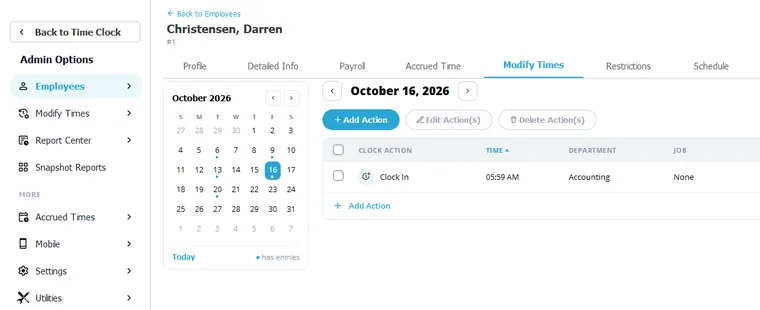
- Lunch and rounding rules are applied the same way every time. TimeClick can deduct lunch automatically after a set number of hours, and its reports can round punches by up to 15 minutes. See rounding laws and TimeClick.
- Edits leave a trail. TimeClick’s audit tools show which times an admin changed or added, who changed them and when.
TimeClick keeps these records on your own Windows PC or server, so you decide how long they’re kept. For more, see employee time tracking compliance.
Labor laws by state FAQ
Do state labor laws override federal law?
Both apply. When they differ, the employer generally follows whichever rule gives the employee more, such as a higher minimum wage.
Which states require meal breaks for adults?
21 states in the table above have a meal break rule for adults, among them California, Colorado, Illinois, Massachusetts, Minnesota, New York, Oregon and Washington. Maryland’s rule covers retail only, Nebraska’s covers certain workplaces only, and Vermont requires only a reasonable chance to eat. Source: the DOL meal period table and state agencies, checked Nov 8, 2026.
Which states have daily overtime?
Five states: Alaska (after 8 hours), California (after 8 hours, double time after 12), Colorado (after 12 hours), Nevada (after 8 hours for employees paid under 1.5 times the state minimum) and Oregon (after 10 hours in some manufacturing and canning work). Everywhere else, overtime is based on the workweek. Source: DOL state minimum wage laws, checked Nov 8, 2026.
Do I have to pay out unused PTO when an employee leaves?
It depends on the state and your written policy. Some states require payout of earned vacation. See PTO laws by state.
How long do I have to keep time records?
Under the FLSA, payroll records must be kept for at least 3 years, and time cards and other records used to work out wages for 2 years (DOL Fact Sheet 21). Some states require longer.
Does federal law require paid sick leave?
Not for most private employers. Several states and cities do; see PTO laws by state.
Can I round employee punch times?
Federal rules allow rounding that evens out over time and doesn’t always favor the employer. See rounding laws and TimeClick.
How does time clock software help with labor law compliance?
It records punches as they happen, totals overtime, applies lunch and rounding rules the same way every time, and logs edits.
Track time and overtime with TimeClick
Employees clock in on a shared PC or the phone app, and TimeClick totals their hours, overtime and time off for payroll, with a one-time license from $299 and unlimited employees.
- 14-day free trial
- No credit card required
- Set up in 10 minutes or less